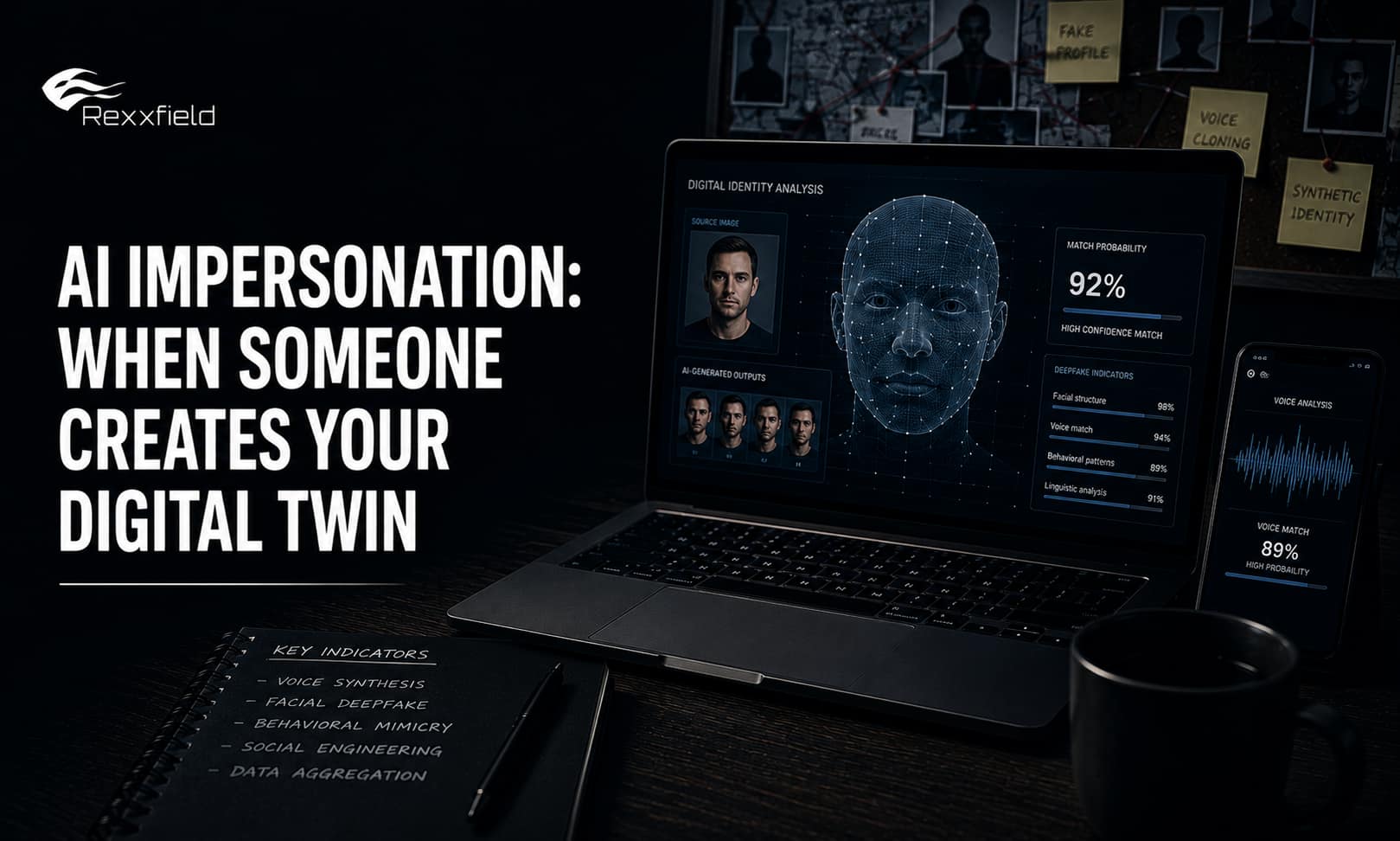
AI impersonation lets an attacker copy a person’s image, voice and writing patterns to build a convincing digital twin. Rexxfield helps clients contain the exposure and trace the real infrastructure, accounts and payment paths the operator still has to use.
Most impersonation cases we see did not start with a stolen password. They started with public material — interviews, podcasts, conference talks, years of social media posts — that gave an attacker everything needed to reconstruct a convincing voice, writing style and biography, then use it to contact people the real person actually knows.

There is more than a fake profile
An AI-enabled impersonator can copy a person’s image, voice, writing patterns, relationships and professional history. Public interviews provide audio; social media supplies context; company websites identify colleagues.
The resulting digital twin may contact employees, clients, journalists or family members to request money, spread claims or manufacture conversations.
Preserve accounts and messages, warn likely targets through trusted channels and identify financial or data exposure. Unnecessary public statements can alert the operator and trigger migration.
We help clients decide what to capture, who to notify and which accounts to secure. Businesses should reinforce independent authentication for payments and sensitive requests.
Uncover the real person behind the aI impersonation
The operator must receive replies, maintain accounts and move victims toward an objective. Those interactions can expose email routing, phone services, domains, payment destinations or reused usernames.
A convincing persona may also reveal private facts known to a small group, contact people in a telling order or become active on a predictable schedule.
Legal and reputational strategy
Attorneys should distinguish fraud, defamation, privacy, trademark and harassment issues rather than assuming one remedy addresses everything.
Rexxfield can work with counsel to identify linked accounts and support precise requests to platforms and service providers.
How Digital Twins Get Built From Public Material
A convincing AI impersonation rarely requires hacking anything. Public interviews and podcast appearances supply voice samples. LinkedIn, company bios and press coverage supply career history and professional relationships. Personal social media supplies tone, slang and the small personal details that make a message feel authentic. Once assembled, that material can be fed into widely available tools to generate new text, images or audio in the target’s style, then aimed at colleagues, clients, journalists or family members who have no reason to doubt what looks and sounds familiar.
Legal Remedies for AI Impersonation
Several legal theories can apply simultaneously, and they are not mutually exclusive. Right-of-publicity and misappropriation-of-likeness claims address unauthorized use of a person’s image or voice; state identity-theft statutes may apply where the impersonation is used to obtain money or information; and platform impersonation policies offer a faster, though narrower, path to account removal and identity verification. Attorneys typically pursue removal and evidence preservation in parallel rather than waiting for one track to finish before starting the other.
Containment Steps in the First 24 Hours
Speed matters more than perfection early on. We typically advise preserving the impersonating account or content before reporting it, since reporting can trigger removal that destroys evidence; identifying which contacts have already been reached, in what order, so the most exposed people are warned first through a trusted channel rather than a public statement; and securing the real person’s own accounts and devices in case the impersonation is paired with an actual compromise rather than pure fabrication. Public denials should wait until the facts are clear, since a premature statement can amplify a fake persona that would otherwise have limited reach.
Why Family Members Are Often the First Target
Attackers frequently approach family members before colleagues, on the assumption that personal relationships carry less institutional skepticism than a corporate finance department. A cloned voice asking a spouse or adult child for urgent help, or a fabricated message referencing a private family detail scraped from social media, can bypass the caution that same person would apply to a work email. Establishing a simple verification habit within families and close circles — a code word, or a rule to always call back on a known number rather than one supplied in the suspicious message itself — closes this gap cheaply and does not require any technical investment.
How Rexxfield Responds to AI Impersonation
Our social media investigation services and digital executive threat intelligence work both apply directly here, since an AI-built digital twin still has to interact with real accounts, payment systems or messaging platforms to do any damage. In one matter, our investigation into a diplomat targeted by an identity-based threat shows how quickly containment and tracing need to happen together once impersonation begins.
Every AI impersonation case begins with containment, then moves to tracing the real infrastructure behind the digital twin.
Related Rexxfield resources: Digital Forensics & Litigation Support • Subpoena Preparation • Identifying Anonymous Bad Actors
Frequently asked questions
What is AI impersonation?
The use of generative tools to imitate a person or organization through text, images, audio, video or coordinated accounts.
Should a fake account be reported immediately?
Preserve it first and coordinate the report so useful evidence is not lost.
How can businesses reduce risk?
Use independent verification, secure executive accounts and maintain trusted confirmation channels.
Can a digital twin be traced?
Often the surrounding accounts, domains, phone services and payment paths provide leads.
Can a digital twin be stopped before it causes damage?
Sometimes, if it is detected early through monitoring of executive names, brand mentions and lookalike accounts, which is why proactive monitoring tends to be cheaper and faster than reactive takedown after contacts have already been deceived.
Sources and further reading
- Rexxfield Fake Business Page Impersonation
- Rexxfield Email Impersonation
- Rexxfield Impersonation Alert
- FBI impersonation alert
Left unaddressed, AI impersonation can spread quickly across platforms, which is why early containment matters.
Request free consultation
AI impersonation will keep getting more polished, but the operator still has to receive replies, move money or maintain accounts somewhere real — and that is where the investigation begins.
A short verification habit, practiced once, tends to outlast whatever new impersonation technique appears next.