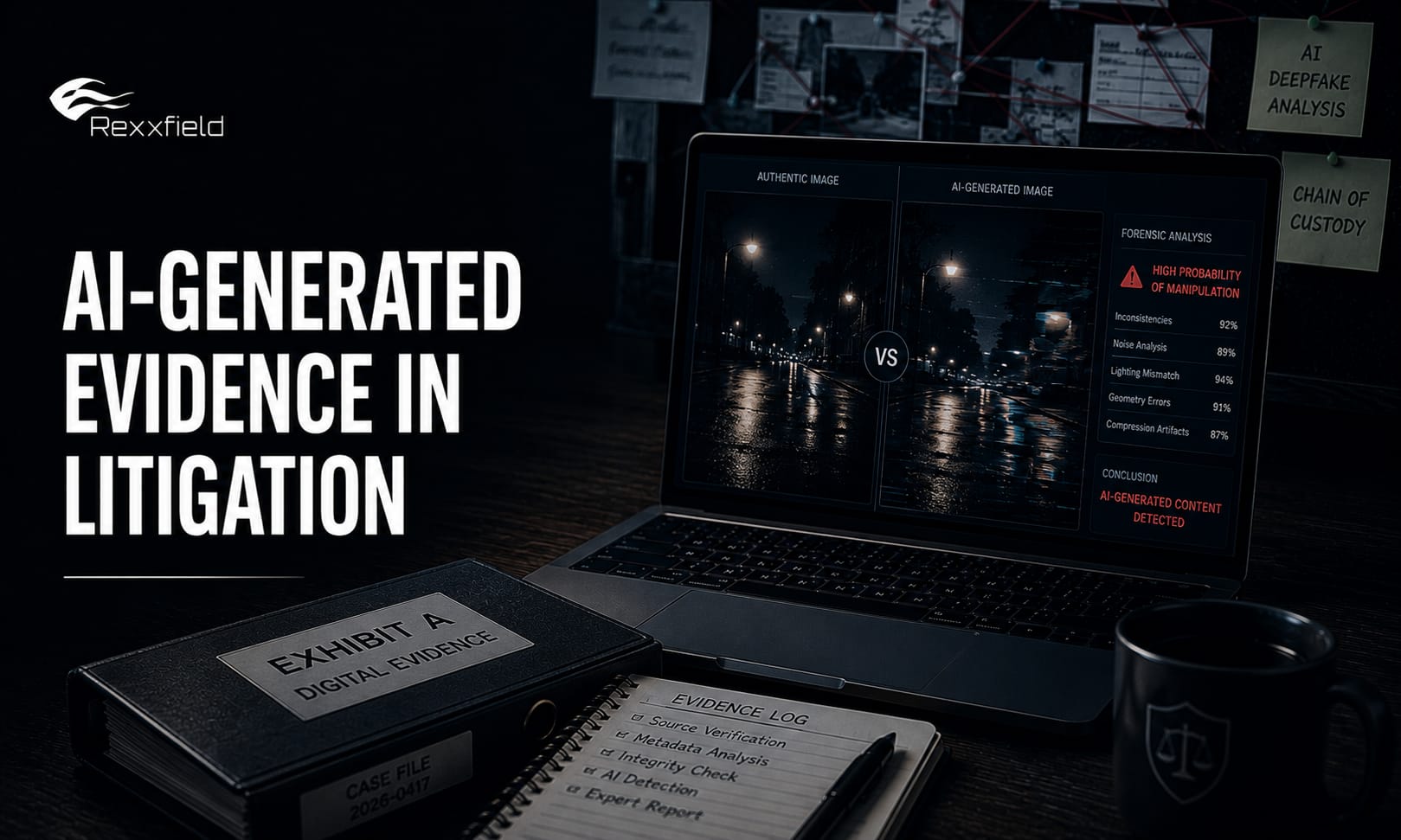
AI evidence disputes tend to start with the wrong question: whether AI was involved at all. Rexxfield focuses on provenance, corroboration and chain of custody, the same fundamentals that make any digital evidence defensible in litigation.
Most disputes over AI evidence do not turn on whether a generative tool was involved somewhere. They turn on a narrower, more familiar question: can the party relying on the file show where it came from, that it has not been altered, and that an independent record supports what it appears to show.
Understanding AI evidence early changes the outcome of a case. Rexxfield treats every AI evidence matter as a distinct evidentiary problem, not a generic AI-abuse complaint.
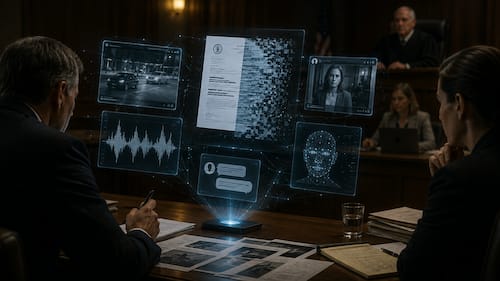
Do not let the AI label distract from evidence basics
When disputed evidence appears, parties may immediately argue about whether AI created it. The more useful starting point is familiar: who produced it, where did it come from, what happened to it and what independent records support it?
Synthetic generation is one possibility among many. A document may be manually altered, a recording selectively edited or a genuine message presented with a false date.
Preserve systems, not only exhibits
Saving an attachment may not preserve the evidence needed to authenticate it. The mailbox, headers, cloud history, source device and related communications may each matter.
A litigation hold should reflect the way the evidence was created and transmitted. Social content may require account exports and URLs; audio may require call logs and application data; documents may require version history.
Provenance and corroboration
Provenance asks where evidence came from. Corroboration asks whether independent records support the event. Chain of custody documents who handled it and what was done.
A clear expert explanation should separate observed facts, analytical inferences and limitations. Measured conclusions are more defensible than certainty unsupported by the record.
Design discovery around the event
Discovery should identify systems and custodians likely to hold original records. Broad demands for all AI-related information may be expensive and unproductive.
Platform records can be perishable. Counsel should consider preservation early, and technical subpoena language should be tailored to the specific account, file or publication event.
Authentication Standards Courts Actually Apply
When AI evidence is disputed under the Federal Rules of Evidence, digital evidence generally still must be authenticated under Rule 901, and Rule 902 provides a narrower path for certain self-authenticating electronic records when specific technical and certification requirements are met. Courts have not adopted a special, heightened standard purely because AI might have been involved; instead, judges continue to ask the same foundational questions they ask of any exhibit — who produced it, how was it obtained, and what corroborates it. An expert’s role is usually to explain, in terms a judge or jury can follow, what was examined, what was found, and where the limits of that analysis lie.
Why Wrongful Accusations Based on Fabricated Evidence Still Happen
Fabricated or misattributed digital evidence has led to real harm well before generative AI made the content easier to produce. In one Rexxfield matter, our investigation helped secure the release of a man imprisoned after being wrongly accused based on electronic messages he did not send, and in another, our work helped clear two women falsely accused of sending threatening texts. Both cases turned on the same discipline this article describes: tracing the messages back to their true origin rather than accepting the surface-level attribution.
Designing Discovery Around Where the Evidence Actually Lives
Broad discovery demands for “all AI-related communications” tend to be expensive, contentious and unproductive. A more effective approach identifies the specific systems and custodians most likely to hold original records — the email server, the messaging platform, the device that captured or received the file — and tailors requests to those sources rather than the technology in the abstract. Platform records are often perishable, so counsel should consider preservation letters and, where appropriate, early subpoenas before the normal discovery schedule would otherwise reach that evidence.
How Rexxfield Authenticates AI Evidence
Our digital forensics and litigation support practice works directly with counsel on authentication disputes, expert reports and preservation strategy, from the earliest evidence-hold letter through trial testimony.
Authenticating AI evidence properly means documenting provenance, corroboration and chain of custody before any conclusion is drawn.
Related Rexxfield resources: Digital Forensics & Litigation Support • Subpoena Preparation • Identifying Anonymous Bad Actors
Frequently asked questions
Is all AI-generated evidence inadmissible?
No. Admissibility depends on applicable rules, purpose, authentication and case-specific circumstances.
How should it be preserved?
Preserve the earliest file, source system, transmission records, metadata and chain of custody.
Can the exact model be identified?
Sometimes clues exist, but exact model attribution may not be possible or necessary.
When should an investigator be retained?
As early as practical, especially when platform records or original files may be lost.
Does a judge need to understand the underlying AI model?
Not in detail. Courts generally care about provenance, integrity and corroboration rather than the specific architecture of the tool that may have been used, so expert testimony typically focuses on what can be verified about the file rather than how a model works internally.
Who typically pays for a digital forensics expert in litigation?
This varies by case type and jurisdiction, but the requesting party usually bears the initial cost, which is one reason focused, well-scoped requests tend to produce better outcomes than broad, speculative ones.
Sources and further reading
- NIST Synthetic Content Report
- NIST Generative AI Profile
- Rexxfield Litigation Support
- Rexxfield Subpoena Preparation
Left unexamined, disputed AI evidence can undermine an otherwise strong case, which is why early authentication matters.
Request consultation with a sSpecialist
The cases above predate the current wave of generative tools, which is the point: the discipline that clears wrongly accused people and authenticates disputed evidence has not changed, even as the content in dispute becomes easier to fabricate.
A measured, well-documented opinion that acknowledges its own limits tends to hold up far better under sustained cross-examination in a contested hearing than a confident claim the underlying analysis cannot fully support.