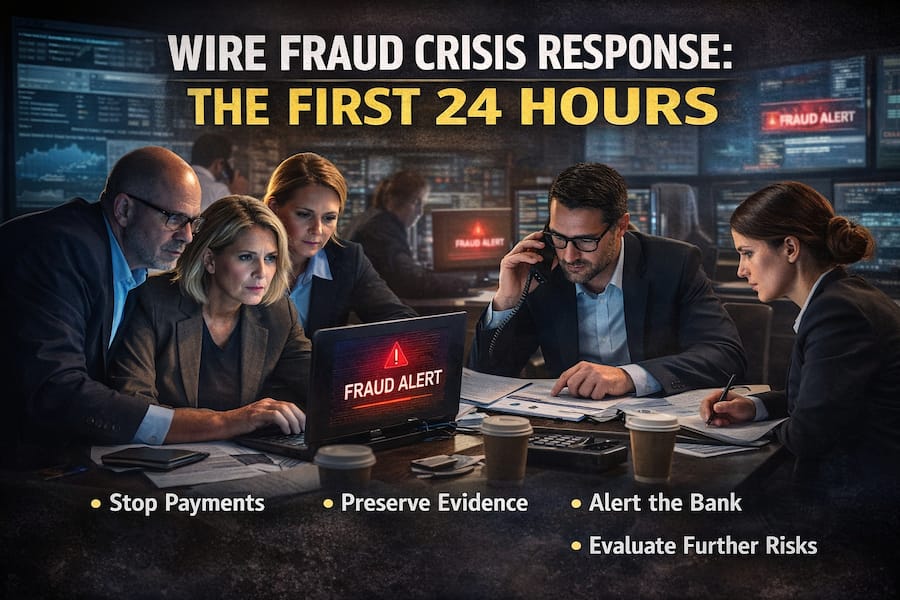
When a wire fraud incident is discovered, the first 24 hours matter more than any other phase of the response. Decisions made in this window shape not only the probability of financial recovery, but also legal exposure, insurance outcomes, regulatory scrutiny, and the organization’s long-term credibility.
This is not a moment for improvisation. It is a moment for discipline.
Request Confidential Incident Guidance
Senior leaders—CFOs, General Counsel, compliance officers, and risk executives—are often forced to make consequential decisions with incomplete information, under time pressure, and amid competing internal priorities. The purpose of this playbook is to provide a clear, defensible framework for navigating those first 24 hours in a way that preserves options rather than forecloses them.
Executive Summary: First 60 Minutes Checklist (Do This Now)
When wire fraud is discovered, speed is everything. The first hour materially impacts recovery odds.
Immediate Actions (0–60 Minutes):
- Freeze all outbound wire activity across treasury systems.
- Contact the executing bank immediately and request a SWIFT recall/hold.
- Ask the bank to issue a SWIFT MT199 or equivalent recall notice.
- Request a “Hold Harmless” and indemnification form if required.
- Escalate internally to CFO, General Counsel, CISO, and executive leadership.
- Preserve email accounts and mailboxes (no deletions or resets).
- Secure compromised credentials (force password resets, disable accounts).
- Preserve system logs (email, VPN, firewall, endpoint).
- Contact receiving bank fraud department if information is available.
- Document timeline of discovery (who, what, when, how).
- Notify cyber insurance carrier per policy requirements.
- Engage external incident response and forensic advisors.
Every minute counts. The probability of recovery declines rapidly after the first few hours.
Understanding the Nature of Wire Fraud Incidents
Wire fraud in corporate environments most commonly presents as business email compromise (BEC), vendor impersonation, executive spoofing, or fraudulent payment diversion. While the technical vectors vary, the underlying mechanics are consistent: manipulation of trust, urgency, and process gaps. Here is exactly how Business Email Compromise attacks work in corporations.
At the moment of discovery, it is often unclear whether the incident is isolated or part of a broader compromise. Treating it as “just a mistake” or “just one payment” is one of the most common—and costly—errors.
The correct assumption in the first 24 hours is uncertainty. Your response must preserve evidence, maintain optionality, and avoid actions that unintentionally contaminate facts or weaken downstream claims.
Why the First 24 Hours Matter
Wire fraud, often driven by Business Email Compromise (BEC) or hacking, is engineered for speed. Funds move through multiple accounts, sometimes across jurisdictions, within hours. Once layered or withdrawn, recovery becomes significantly more difficult.
A disciplined, hour-by-hour response improves:
- Probability of freezing funds
- Legal positioning
- Insurance recovery
- Regulatory compliance
- Litigation defensibility
What follows is a practical timeline your team can execute under pressure.
Hour 0–2: Stabilize Without Distorting the Evidence
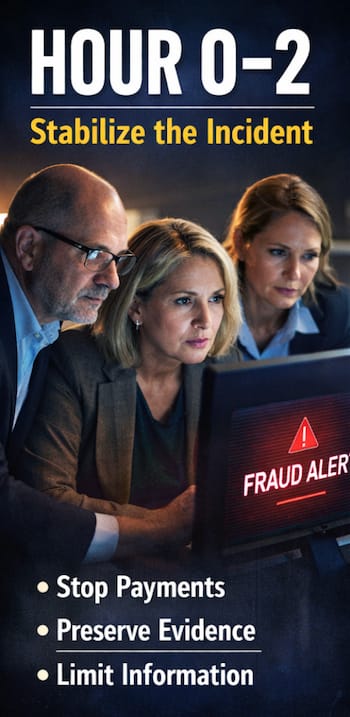 The instinctive reaction after discovering wire fraud is to act quickly and broadly—reset passwords, notify everyone, remediate systems, and “fix” what appears broken. While speed is important, uncoordinated remediation can permanently damage evidentiary integrity.
The first objective is stabilization, not resolution.
Key Actions
- Stop additional payments immediately.
- Preserve systems in their current state.
- Limit internal dissemination to a small response group.
Why This Matters
Evidence collected in the first hours often becomes the foundation for insurance coverage determinations, law enforcement engagement, regulatory inquiries, and internal governance reviews.
Stephen Dougherty, CEO of Rexxfield, notes:
“In almost every wire fraud case we see, the biggest losses aren’t just financial—they’re evidentiary. Once the record is altered, you can’t go back and recreate it. The organizations that fare best are the ones that slow down just enough to preserve the truth.”
Hour 2–6: Secure the Financial Perimeter
Once immediate stabilization is achieved, the focus shifts to financial containment and recovery efforts.
Bank Notification and Recall
Contact the financial institution that executed the wire transfer as soon as possible. Provide factual transaction details without speculation, and document all communications.
Parallel Financial Review
Conduct a controlled review of recent transactions for pattern indicators while avoiding premature remediation.
Why This Matters
Early financial discipline demonstrates governance and reasonableness—critical factors when insurers, auditors, and regulators later assess the organization’s response.
Hour 6–12: Evidence Collection and Legal Framing
This phase is where many organizations unintentionally undermine themselves.
Evidence Preservation
Evidence should be collected in a forensically sound manner, including email headers, access logs, audit trails, and messaging records.
Legal and Insurance Alignment
General Counsel should actively guide privilege strategy, insurance notification timing, and disclosure posture.
Anna Hulst, investigations lead at Rexxfield, explains:
“What we see time and again is that organizations think they’re protecting themselves by staying quiet or fixing things internally. In reality, early documentation and disciplined disclosure are what protect credibility later—especially when insurers and regulators start asking hard questions.”
Hour 12–18: Scope Assessment Without Assumptions
 By this point, leadership often wants answers. These questions are valid—but premature conclusions can be damaging.
Controlled Scoping
The objective is understanding scope, not attribution certainty. Avoid definitive language unless findings are conclusive.
Governance and Oversight
Document decisions, rationales, and uncertainties to support later scrutiny.
Hour 18–24: External Posture and Strategic Optionality
As the first day closes, attention turns to outward-facing posture.
Law Enforcement Considerations
Engagement should be coordinated, factual, and consistent across leadership.
Regulatory Awareness
Even when notification is not mandatory, regulators often evaluate timeliness, controls, and executive oversight.
Internal Communications
Clear, confident internal messaging supports organizational stability.
How To Respond to Wire Fraud in the First 24 Hours (Step-by-Step)
- Freeze outgoing wires immediately.
- Call the executing bank and request a recall.
- Escalate to executive leadership.
- Preserve and secure compromised accounts.
- Lock down email and cloud access.
- Audit recent payment activity.
- Notify cyber insurance carrier.
- Engage legal counsel.
- File law enforcement complaint.
- Launch forensic investigation.
- Assess regulatory obligations.
- Implement strengthened payment controls.
This structure helps organizations avoid reactive chaos and move decisively.
The Strategic Throughline: Decisions, Evidence, Consequences
Every choice in the first 24 hours creates ripple effects across financial recovery, legal exposure, and regulatory outcomes. Disciplined decision-making—not panic—determines success.
A Measured Path Forward
Wire fraud incidents are high-stakes events, but they do not have to become organizational crises. Calm, structured response preserves options and protects leadership.
Independent or expert support may be appropriate when internal capacity is exceeded or when evidentiary integrity is essential to long-term outcomes.
For additional context, visit: https://rexxfield.com/wire-fraud-financial-crime-investigations/
Discuss Independent Support Options
Frequently Asked Questions
What should you do immediately after discovering wire fraud?
Call your bank and request a recall before doing anything else. The faster the recall is initiated, the higher the chance of freezing funds.
Can wire fraud funds be recovered?
Yes — particularly if identified within hours and funds have not yet been withdrawn or layered. Recovery probability decreases significantly after 24–48 hours.
Should we contact law enforcement right away?
Yes. Filing with the FBI IC3 and working with your bank can activate fraud recovery protocols, especially for domestic transfers.
Do we need to notify our cyber insurance carrier?
Immediately. Many policies require prompt notice. Delay can jeopardize coverage.
Is wire fraud always a cybersecurity incident?
Not always — but in most BEC cases, email compromise is involved. A forensic review is strongly recommended.
Need Immediate Incident Guidance?
If your organization is dealing with wire fraud or a Business Email Compromise event, time matters.
Request Confidential Incident Guidance
Our team coordinates banking escalation, forensic response, legal alignment, and recovery strategy — discreetly and rapidly.