If Someone Accessed Your Computer and Money Was Stolen, Do This Immediately
If you gave someone remote access to your computer and now see unauthorized transactions, you may be dealing with remote desktop wire fraud or an account takeover attack.
Act immediately:
- Disconnect your device from the internet
- Call your bank and request a fraud hold or wire recall
- Ask your bank to contact the receiving bank immediately
- Remove any remote access software from your device
- Secure your accounts, change passwords, revoke sessions
- Preserve all communications, logs, and transaction details
- File a report with the FBI IC3
https://www.ic3.gov - Engage investigators early to trace the funds
The first 24 hours often determine whether recovery is possible.
See our wire fraud corporate play book for first 24 hours
Can Money Be Recovered After Remote Access Fraud?
Sometimes, yes.
But recovery after remote access wire fraud depends on:
- How quickly the fraud is reported
- Whether funds are still in initial accounts
- How fast banks respond
- Whether the movement of funds can be traced
After the first 24 to 72 hours, recovery becomes significantly more difficult.
Working With Banks on Recovery
When it comes to remote desktop wire fraud, timing matters, but so does who is involved early.
We work directly with a wide network of U.S. financial institutions and have built strong working relationships over years of handling these cases. That experience shows up in how quickly and effectively we can engage when funds are moving.
In many situations, banks are dealing with limited or fragmented information in the first hours of a fraud event. We help bridge that gap by providing clear, structured intelligence on transaction flow, timing, and movement across accounts. That allows banks to act faster and with more confidence.
We also understand how recovery processes actually work behind the scenes, where delays happen, and what information banks need to prioritize a case. That insight can make a meaningful difference in fast-moving situations.
We have a strong track record working alongside banks on recovery efforts, particularly when we are brought in early. While no recovery is ever guaranteed, early engagement significantly improves the chances of limiting loss and, in some cases, recovering funds.
If funds have already moved, every hour counts. Getting the right people involved early can change the outcome.
Request free consultation about wire fraud recovery
Remote Desktop Protocol and Wire Fraud: What We Are Seeing
At Rexxfield, we continue to see a steady stream of wire fraud and account takeover cases linked to remote desktop access.
What stands out is not just the frequency, but the consistency.
These are not random events. They are repeatable playbooks used by threat actors across industries and demographics.
While remote desktop tools serve legitimate purposes, they are increasingly being used to gain full control over a victim’s device, and from there, their financial accounts.
This tactic continues to impact individuals and businesses alike, including financially sophisticated professionals.
 How Remote Desktop Becomes a Fraud Entry Point
Remote desktop software allows someone to control a computer as if they were physically sitting in front of it.
That is exactly why remote desktop wire fraud is so effective.
Across remote desktop wire fraud investigations, the pattern is consistent.
Step 1: Social Engineering or Fake Alerts
Victims are prompted by:
- Pop-up warnings claiming their device is compromised
- Fake “bank fraud” alerts
- Calls from impersonated technical support or financial institutions
- Phishing messages urging immediate action
These messages create urgency and push the victim toward granting access.
Step 2: Remote Access Is Installed
Victims are guided to install remote access software or enable built-in remote desktop functionality.
Sometimes knowingly. Sometimes unknowingly.
In many cases, the attacker stays on the phone, walking the victim through each step.
Step 3: Full Device Control
Once access is established, the attacker can:
- Observe everything on the screen
- Open files and applications
- Access saved browser credentials
- Enter online banking sessions already logged in
Because activity originates from the victim’s own device and IP environment, it often bypasses fraud detection systems.
Step 4: Account Takeover and Fund Movement
With access secured, the attacker can:
- Initiate wire transfers
- Send ACH payments
- Add new payees
- Modify account details
In many cases, the victim is still on the phone while transactions are being executed.
The attacker maintains control of the narrative, preventing intervention.
Why Remote Desktop Wire Fraud Is So Effective
This method works because it combines:
- Technical access
- Human manipulation
From an investigative standpoint, several factors make it particularly dangerous:
- Activity appears to originate from the victim’s own device
- Saved browser credentials remove the need for password theft
- Victims often assist unknowingly
- Fraudsters manipulate screens in real time to reinforce legitimacy
We frequently see this tactic paired with:
- Tech support scams
- Investment scams
- Account impersonation schemes
- Business email compromise attacks
Rexxfield Observations From Recent Cases
Across remote desktop wire fraud investigations, several patterns continue to stand out:
- Remote desktop software often remains installed long after the incident
- Victims are unaware access is still active
- Browser-saved credentials accelerate financial theft
- Funds can be transferred within minutes of access
These are not edge cases.
They are common.
How to Prevent Remote Desktop Wire Fraud
At Rexxfield, one of the simplest and most effective recommendations is:
Remove Remote Desktop Software If You Don’t Need It
This alone can eliminate a major attack vector.
Additional steps:
- Disable remote desktop services when not in use
- Never grant access to unsolicited callers
- Avoid pop-ups claiming urgent compromise
- Use password managers instead of browser-stored credentials
- Enable multi-factor authentication
- Regularly review installed applications
How Rexxfield Investigates Remote Desktop Wire Fraud
When remote desktop wire fraud occurs, the focus shifts to understanding:
- How access was gained
- What actions were taken
- Where funds were sent
At Rexxfield, we assist by:
- Conducting compromise analysis and timeline reconstruction
- Identifying installed remote access tools and persistence mechanisms
- Tracing funds across accounts and institutions
- Coordinating with banks on recovery efforts
- Supporting legal and law enforcement processes
Our approach combines technical analysis with financial tracing.
Because in these cases, following the money is critical.
If You Are Dealing With Remote Desktop Fraud
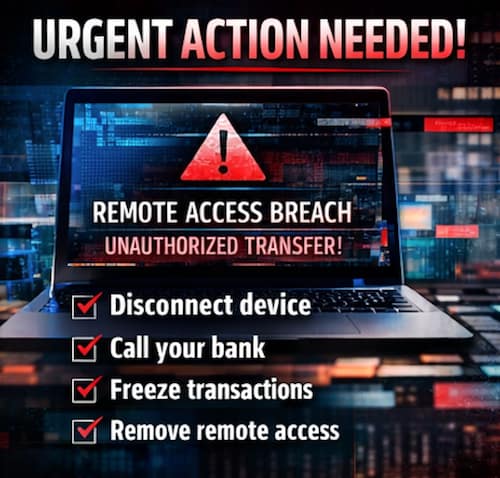 If you believe remote access was used to compromise your device or accounts:
- Disconnect immediately
- Contact your bank
- Preserve your evidence
Find out how our wire fraud investigators can help if you need help understanding what happened or tracing funds.
Early intervention can significantly improve recovery outcomes.
Contact our wire fraud investigators
Frequently Asked Questions
Can scammers access my bank account through remote desktop?
Yes. If remote access is granted, attackers can use your device to access banking sessions, saved credentials, and financial applications.
What happens if I give remote access to a scammer?
They may gain full control of your device, monitor activity, and initiate financial transactions without your knowledge.
Can money stolen through remote access be recovered?
Sometimes, especially if action is taken quickly within the first 24 to 72 hours.
How do I remove remote access after a scam?
Uninstall remote desktop software, disconnect the device, and conduct a full security review. Professional assistance is often recommended.
How do investigators trace remote access fraud?
Investigators analyze device activity, access timelines, financial transactions, and infrastructure used to move funds.