Hey, I’m the CEO, can you send me an urgent wire transfer? Can you run an errand and pick up a few gift cards? CEO impersonation are one of the most common Business Email Compromise attacks. What often starts as an innocent spam-looking email can quickly turn into thousands or hundreds of thousands of dollars in losses. BEC isn’t just limited to small tasks, threat actors target real estates, title companies, and virtually anyone who’s responsible for wiring any amount of money.
So let’s take a step back and look at how BEC attacks actually work within a corporation. And by “actually” work I mean how it’s really working in your corporation.
Employees / Targets are Stressed and Overworked, Leading to Increased Susceptibility
With looming deadlines, bosses that are constantly breathing down your neck, helicopter micro-managers who forgot that employees are actually smart, and processes that laugh in the name of efficiency, company safety is really the last thing on the mind of your employees. Sure, they took that safety course at the beginning of the year so you could check a box, but did they really pay enough attention play the “spot the fake CEO” game? Probably not because of the other issues at hand.
Sure, if an employee sees a massive pop up that says their computer is infected, IT is going to get a call. Hovering over an email to see an upper-cased I verses a lower-cased L is a level of skepticisim that most aren’t wired for.
If you’ve been targeted or already suffered a financial loss, start here:
Learn about our wire fraud investigations
We want to Make the CEO Happy. Can I get a Raise Now?
Rexxfield has done a lot of work with employees and customers, and through all of the BEC investigations we’ve done over the years, one thing is for certain: employees want to make higher-ups happy. This often comes in the form of instantly doing a wire transfer or listing when executives need a “special task” completed, because c’mon, who doesn’t want to make the CEO happy? Does this mean I might get a bigger pay raise at the end of the year? You bet I’m going to run that quick errand!
Emotionally, victims get excited at the chance to help, however this can often lead to them having blinders on when a scam is looming. They will be less scrupulous of that PDF file containing wiring instructions, especially when it looks legitimate.
I Copy / Pasted a Signature Body and am now Who I Say I am
Attackers don’t need to be elite hackers to impersonate someone inside your organization. In fact, they barely need technical skill at all. The easiest door in is often just reading your emails—and once they’re in, they can become you with shockingly little effort.
Here’s how it usually plays out:
- They compromise an email account through a phishing link or reused password.
- They quietly read weeks (sometimes months) of messages.
- They learn your tone, your writing rhythm, who you talk to, who you approve payments for, what projects are active, and what your signature block looks like.
Then the magic trick happens:
They copy/paste your signature, and suddenly they are you.
Logos, disclaimers, confidentiality blurbs, job titles, even the little “sent from my iPhone” with the odd formatting — attackers replicate all of it with a few clicks.
And because most employees are trained to skim emails fast, those visual anchors carry massive psychological weight. If the signature looks legitimate, the request must be legitimate… right?
Even worse, attackers often modify the signature before using it:
- Insert a “new direct line” that’s actually their burner phone
- Add an alternate email that routes to another compromised account
- Slightly change the reply-to address so responses go straight to them
To an employee, the message feels safe. But behind the scenes, the attacker has built a nearly perfect costume using pieces stolen from your real communications.
But they Responded to the Email Thread, they have to be Legit!
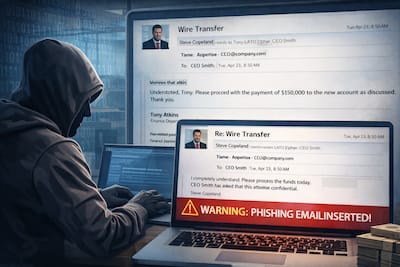 This is the number one misconception victims have after a BEC incident:
“But the scammer replied to the existing chain, so it had to be real!”
Unfortunately, this is exactly what happens when an attacker has gained access to a legitimate mailbox.
When they’re inside:
- They can hit “Reply All” on a genuine conversation.
- They can continue the dialogue naturally because they’ve read the previous context.
- They can wait for the perfect financial moment — closing day, payroll, vendor payout, year-end rush — and insert “updated wiring instructions” at the exact right time.
This isn’t spoofing. This isn’t pretending. This is an attacker literally participating in your real email threads.
And if employees assume that “responded to the thread = safe,” attackers exploit that blind trust every single time.
The scary part? They don’t even need long-term access. Just a few hours inside a mailbox can be enough for them to harvest documents, impersonate both sides, and vanish before anyone notices.
Tips and Fixes to Address BEC that Aren’t Selling you Something
Here’s the part where most blogs pivot into selling a tool, a platform, or a subscription. We’re not doing that. These are the fixes that work immediately, cost nothing, and drastically reduce your BEC risk.
-
Stop Moving Money Without Voice Verification
Any request involving updated wiring instructions, vendor changes, or “urgent transfers” should require a live call to a verified number already on file.
Not the number in the email.
Not the number in the signature block.
Not the number texted to you moments before.
It sounds simple because it is — and it stops millions of dollars in fraud every year.
-
Make Urgency a Red Flag, Not a Command
Attackers rely on panic and speed. Build a culture where urgency slows people down instead of speeding them up.
If the CEO “needs this right now,” the employee should think:
Perfect, let me verify this even harder.
-
Normalize Employee Skepticism
Employees often fall for BEC because they don’t want to disappoint leadership.
Fix that at the cultural level:
- Praise people for double-checking.
- Celebrate when someone reports a suspicious message.
- Make it clear that asking “did you really send this?” is smart, not insubordinate.
-
Audit Mailbox Rules Regularly
The #1 indicator of a compromised account isn’t a weird email — it’s mailbox rules silently forwarding or deleting messages.
IT should check for:
- Auto-forwarding to external addresses
- Rules that delete financial or invoice emails
- Newly added signature blocks or alternate reply-to addresses
These things should trigger an instant investigation.
-
Teach Employees What “Normal” Looks Like
Executives have predictable behaviors. Attackers mimic them.
Help employees recognize patterns like:
- Does the exec normally ask for secrecy?
- Do they usually send one-line emails with no punctuation?
- Have they ever asked for gift cards?
When employees understand real patterns, fake patterns stick out.
-
Reduce Access, Reduce Damage
If a single compromised mailbox can approve or initiate payments, that’s a design flaw.
Split duties. Add approvals. Limit visibility. Assume compromise will happen, and design systems that don’t hand attackers the keys.
-
Make Verifying Things Easy (and Shame-Free)
Employees shouldn’t fear IT. They shouldn’t fear looking dumb.
Create simple, judgment-free reporting channels:
- A Teams/Slack channel: “Is this real?”
- A one-click phishing report button
- Fast IT response times that don’t punish people for asking
The easier it is to verify, the harder it is to scam.
More ways to protect yourself.
Were you attacked with a Business Email Compromise attack? The first 24 hours is critical, here is what to do.
Did you get Hit with a BEC? That’s Where we Come in
Did you get hit with a BEC attack and need help recovering? That’s where we come in. 
Rexxfield has spent years untangling wire‑fraud schemes, tracing criminal infrastructure, working with law enforcement, and helping victims reclaim their money and their peace of mind. We don’t sell fear, and we don’t hide behind buzzwords — we investigate, recover, and stop the bleeding fast.
Whether your organization just lost funds, discovered a compromised mailbox, or realized someone slipped into an email thread weeks ago, the clock matters. The sooner you act, the higher the chances of recovery.
If you’ve been targeted or already suffered a financial loss, start here:
Learn about our wire fraud investigations
Rexxfield can help you understand what happened, preserve evidence, identify the threat actor’s path, and work toward financial recovery — no upsell, no scare tactics, just real-world expertise when you need it most.