Anonymous online harassment creates an unusual legal problem. The client may have substantial evidence of the conduct but no defendant to name.
There are threatening messages, defamatory posts, impersonation accounts or repeated unwanted contact. The behaviour may have continued for months. Yet the anonymous online harasser is hiding behind usernames, temporary email addresses or fake profiles.
For attorneys considering litigation, identifying that person can become the first major obstacle.
At Rexxfield, anonymous actor investigations are a significant part of our work. We are often engaged when a client or attorney has exhausted the obvious searches and needs to determine whether the digital activity can be attributed to a real person.
The important point is that anonymous is not the same as unidentifiable.
Attribution Requires Corroboration
Imagine an anonymous account repeatedly sending threatening messages to a company executive. The account uses a username also found on a gaming forum. The forum account references a particular city. That is interesting, but it does not identify anyone.
Now suppose the gaming account links historically to another profile containing a distinctive photograph, in the same way we traced a single persona in an anonymous Twitter/X account investigation. That image appears on an older social account. The social account identifies an individual living in the same city. Posting patterns, interests and other independent details are consistent across the identities.
The evidentiary picture is becoming stronger. No single connection necessarily proves attribution. Instead, investigators build a network of corroborating evidence.
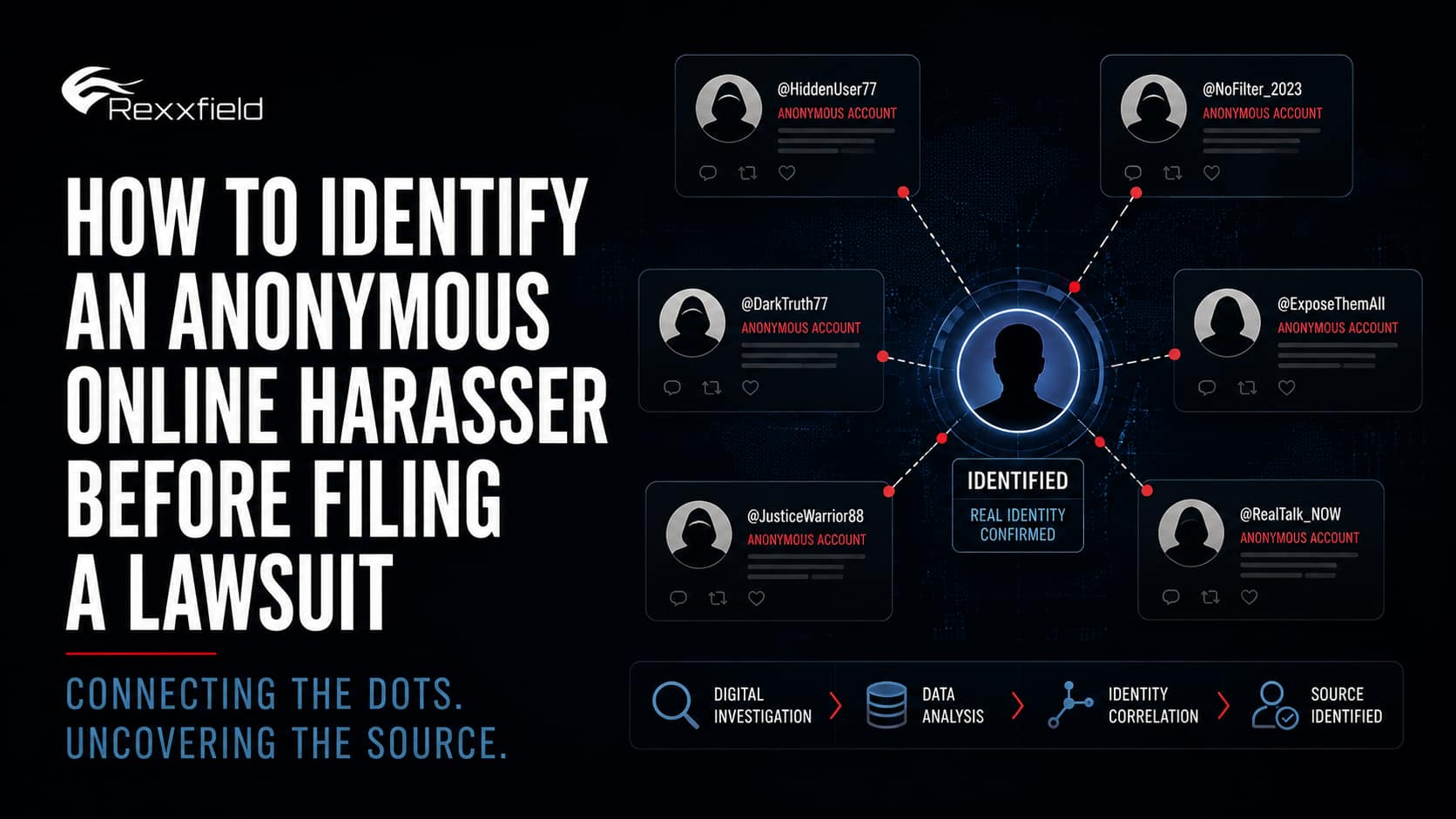
The objective is not to find one dramatic clue, but to establish multiple independent connections that point toward the same operator. That is the essence of an anonymous harasser investigation: connecting fragments until the evidence can identify person behind anonymous account activity beyond reasonable doubt.
Multiple Accounts Can Be Part of the Same Campaign
One of the most important questions in harassment investigations is whether the victim is actually dealing with multiple people.
A client may receive attacks from five social media accounts and assume five individuals are involved. That may be true. But increasingly, we encounter situations where one person operates numerous personas.
Generative AI makes this significantly easier, a dynamic explored further in our analysis of AI-powered harassment campaigns. AI can produce different profile photographs, writing styles, biographies and posts. A perpetrator can create an artificial crowd around the victim, making the harassment appear much larger than it actually is.
Investigators therefore look for relationships between accounts. Timing, interaction patterns, reused assets, shared infrastructure, behavioural similarities and historical connections can sometimes reveal that apparently independent identities are part of the same operation. Investigators who identify anonymous social media account activity across multiple platforms are often able to show that this is anonymous cyber harassment orchestrated by one operator, not several unrelated accounts.
Preserve the Harassment Before Accounts Disappear
Attorneys should encourage clients to preserve evidence early. Harassers frequently delete content. They may also change usernames, deactivate accounts or remove material once they realise that legal action is being considered.
A screenshot is better than nothing, but investigators benefit from having the original context wherever possible. URLs, account identifiers, timestamps, profile information, surrounding conversations and related posts can all become relevant.
For serious threats, attorneys should of course consider whether law enforcement involvement is appropriate, including reporting through the FBI’s cyber crime program or, for infrastructure and platform-level abuse, CISA.
What Investigators Can Do Before a Subpoena
There is sometimes an assumption that an anonymous account cannot be investigated until a platform is subpoenaed. That is not necessarily the case.
A considerable amount of attribution work can often occur before legal process, including the kind of IP and identifier tracing described in can a private investigator trace a phone number or IP address. Open source intelligence can identify historical accounts, relationships, websites, domains, aliases, public records and other digital traces.
Investigators can also determine which pieces of information are missing. That distinction matters.
A good investigation may not always establish identity conclusively from public information alone. But it can narrow the field considerably and identify exactly which records could resolve the remaining uncertainty. That can make legal discovery far more targeted. This matters most in anonymous cyber harassment cases, where the perpetrator may operate across several platforms before a subpoena is ever filed.
When a Subpoena Becomes Necessary
Some evidence simply is not public. A platform may hold subscriber information or technical records that could assist attribution. Access to that material may require litigation and appropriate legal process.
The attorney should determine the legal mechanism available in the relevant jurisdiction — the point at which many of these matters move from open-source work toward a John Doe filing. The investigator’s role can complement that process.
For example, if an investigation has identified several related accounts, counsel may be able to seek information concerning those specific accounts rather than beginning with a single isolated username. Likewise, identifying relevant dates or associated infrastructure may help narrow requests.
Investigation and legal discovery are therefore not competing approaches. In many cases, the strongest strategy uses both.
Avoid Confronting the Suspect Too Early
There is another reason to investigate before filing. Once a suspected harasser becomes aware that they are being investigated, their behaviour may change.
Accounts can disappear. Historical posts can be deleted. Websites can be taken offline. Connections between personas can be severed.
That does not mean attorneys should never send demand letters or contact suspected perpetrators. It means the timing of that step should take evidence preservation and attribution into account.
Where possible, we generally want to understand the digital landscape before alerting the person operating within it.
What a Useful Attribution Report Should Tell Counsel
A report on any anonymous online harasser should distinguish between fact and analysis. It should explain what was found, where it was found and why particular connections matter.
Most importantly, it should communicate the strength of the conclusion. There is a major difference between saying that two accounts use similar language and saying that multiple independent indicators connect those accounts to the same individual.
Counsel needs to understand that difference. At Rexxfield, particularly where litigation is anticipated, we prepare our investigations knowing that findings may ultimately need to withstand scrutiny.
Identifying the Person Behind the Account
Anonymous harassment can feel impossible to investigate because the victim sees only the account presented to them. Investigators look beyond that account.
We examine the wider ecosystem around it: historical identities, relationships, digital infrastructure, behavioural patterns, publicly available records and the traces left across different parts of the internet.
Sometimes that produces a strong attribution. Sometimes it identifies a small number of likely actors. And sometimes the evidence shows that further legal discovery is required.
For an attorney deciding whether and how to file a lawsuit, each of those outcomes provides something valuable: a clearer understanding of who may actually be on the other side of the case. That is the value of a properly scoped anonymous harasser investigation before litigation begins.
How Rexxfield Can Help
This article is the third in a three-part series on unmasking an anonymous online harasser, for attorneys handling online defamation and anonymous harassment matters. Read the first two articles: Online Defamation Investigations for Attorneys and Pre-Litigation Investigations in Online Defamation Cases.
If you are representing a client dealing with anonymous defamation, harassment or coordinated online abuse, Rexxfield can assist with evidence preservation, attribution investigation and litigation support. Engaging early can help counsel understand what evidence exists, what can be established independently, and where legal process may be required.
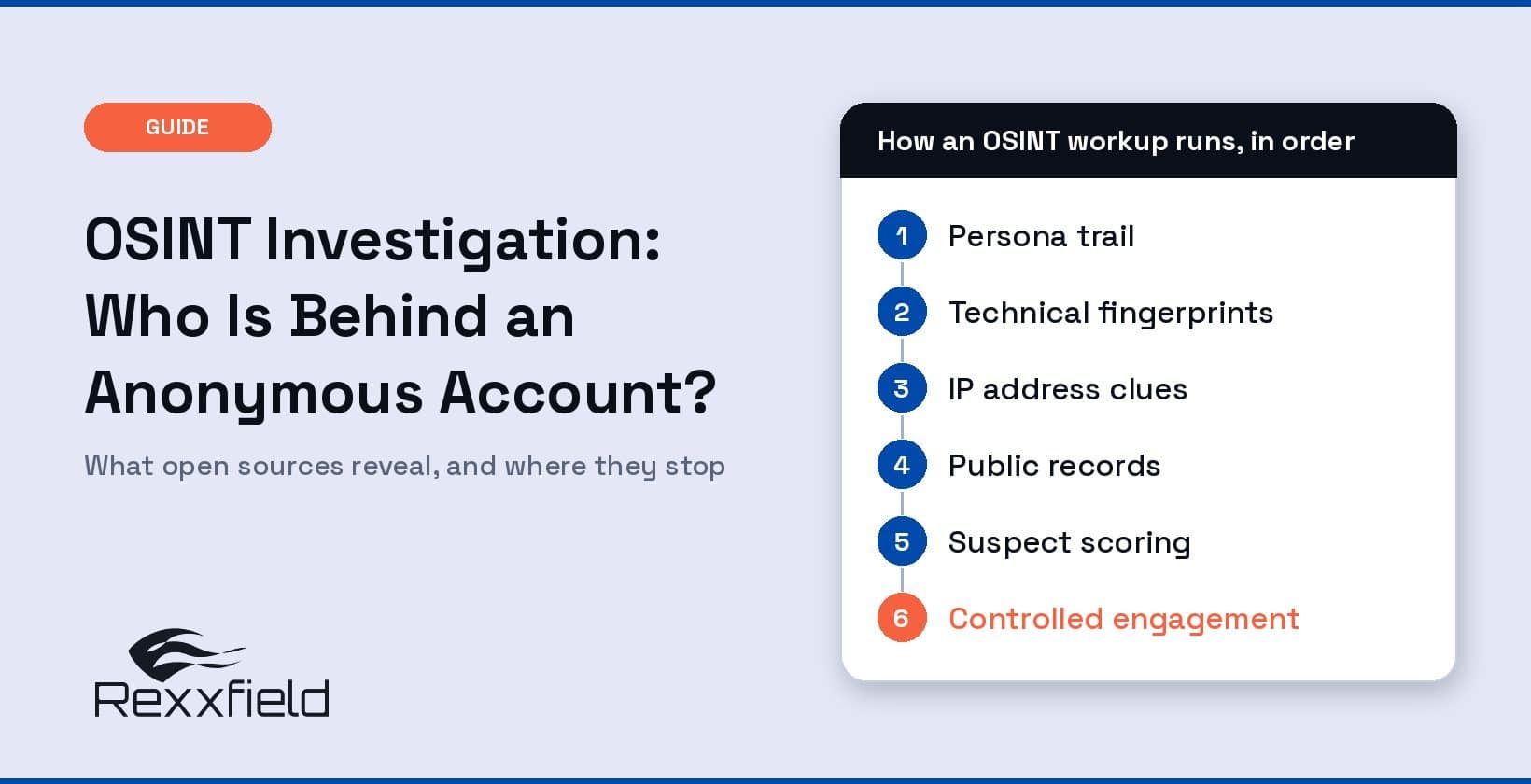
Learn how an OSINT investigation identifies an anonymous account, what an IP address tells you, and where a subpoena becomes necessary.