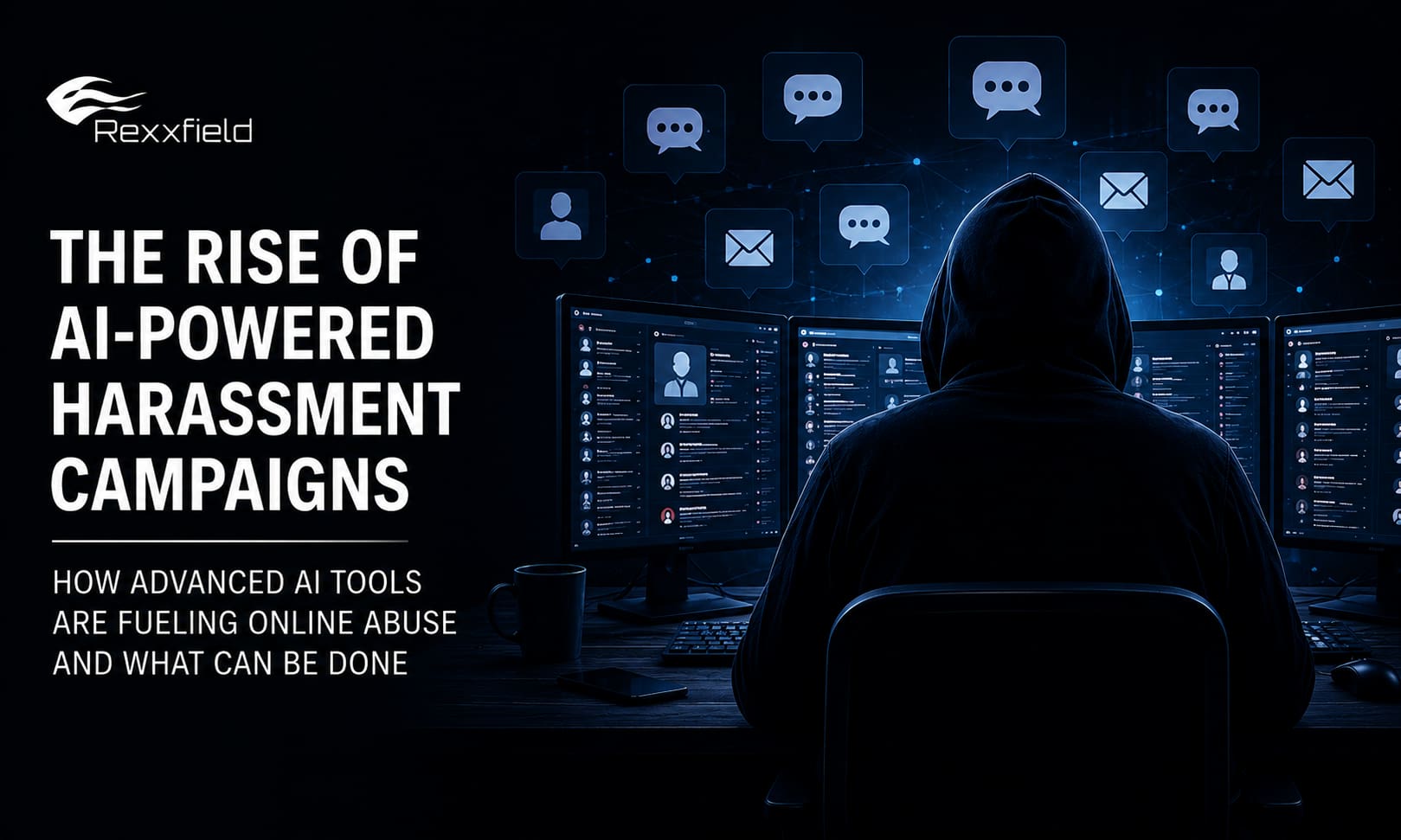
AI harassment campaigns can make a single operator look like dozens of independent attackers, using generated personas, biographies and messages at scale. Rexxfield investigates the technical and behavioral fingerprints that separate genuine coordination from one person hiding behind many accounts.
AI harassment complaints rarely arrive as a single message. By the time a client contacts Rexxfield, they are often facing dozens of accounts, hundreds of messages, or a review-bombing campaign that appears to involve far more people than actually exist. Distinguishing genuine coordination from one determined operator using generative tools is the first investigative question we answer.
Understanding AI harassment early changes the outcome of a case. Rexxfield treats every AI harassment matter as a distinct evidentiary problem, not a generic AI-abuse complaint.
One person can now look like a crowd
Coordinated harassment once suggested a group. That assumption is no longer safe. One operator can use generative AI to write hundreds of distinct messages, create plausible biographies, translate attacks and maintain several fake personas at once.
The apparent number of participants creates pressure. Employers, platforms and family members may act before the underlying claims are tested. We separate volume from independence by examining account creation, timing, operational habits, repeated private facts and technical connections.
Fake personas and chatbot-assisted stalking
AI makes a fake identity easier to maintain. An operator can generate profile photographs, career histories and conversational responses that appear consistent over time. Chatbots can help monitor a target’s public activity and rapidly tailor messages.
The technology does not remove human intent. Our focus is the person who selected the target, supplied private facts and directed the activity. Victims should avoid engaging every new persona, because replies can reveal what causes distress and provide fresh material.
Review bombing and social amplification
AI-assisted review bombing can create a false appearance of widespread dissatisfaction. We do not rely on whether writing ‘sounds like AI.’ We examine account histories, timing, geographic claims, factual errors and links with other campaign assets.
Rexxfield has long investigated fake reviews and anonymous online actors. AI changes production, but the evidentiary questions remain familiar: who controlled the accounts, what links them and what relationship explains the targeting?
Finding the human operator
We map accounts, posts, domains, email addresses, phone numbers and key events on a shared timeline. The operator may reuse a username, upload the same image, expose infrastructure or reveal a predictable local schedule.
Attorneys should preserve evidence before platforms suspend accounts. Takedown may stop publication while also making public evidence harder to capture.
Legal Options for AI Harassment Victims
Harassment that escalates through AI-generated messages, fake profiles or automated posting is still harassment in the eyes of the law, and most jurisdictions treat it that way. Many U.S. states have criminal cyberstalking or harassment statutes that apply regardless of whether a human or a tool authored the individual message, and civil protective or restraining orders remain available once a respondent is identified. Section 230 protects platforms from liability for user content, but it does not shield the person who created and directed the campaign. Where the harasser’s identity is unknown, a John Doe lawsuit paired with early-stage subpoenas to platforms, email providers and phone carriers is often the fastest path from anonymous account to named defendant.
Red Flags That Distinguish AI-Assisted Harassment From Genuine Coordination
Investigators examining AI harassment look for specific markers rather than assuming volume equals conspiracy. Accounts created within the same short window, profile photos that trace back to the same generative source or stock library, near-identical sentence cadence despite claimed different authors, consistent posting times suggesting a single time zone, and reused usernames or contact details across supposedly unrelated profiles all point toward one operator rather than many. We map these indicators on a shared timeline alongside the content itself, because a captured screenshot rarely tells the whole story on its own.
Preserving Evidence Before You Report
Screenshots alone are rarely enough. Platforms and courts give more weight to full account exports, original message headers, and metadata than to a cropped image, and each of those can disappear the moment an account is reported, blocked or suspended. Before filing a report, we generally recommend downloading the platform’s official data-export tool where one exists, logging URLs and timestamps for every relevant post or message, and resisting the urge to engage the harasser directly, since replies often reveal what causes distress and hand the operator fresh material to escalate with. A short written timeline, kept contemporaneously, also becomes one of the more persuasive exhibits once a matter reaches an attorney or investigator.
How Rexxfield Investigates AI Harassment Campaigns
Our social media and harassment investigations combine social media investigation services with techniques used to identify anonymous antagonists, building an evidentiary record that holds up with platforms, law enforcement and courts. In one matter, our work tracing a phone number back to a person unmasked a year-long anonymous harassment campaign traced to a family member using disposable numbers and spoofing services — the same investigative approach applies when generative AI is used to diversify or scale the harassing content itself.
Frequently asked questions
Can one person create the appearance of a coordinated campaign?
Yes. AI can help one operator manage multiple personas and large volumes of varied content.
How are fake personas linked?
We compare technical, behavioral, temporal and contextual indicators rather than writing style alone.
Should victims reply?
Usually, unplanned engagement creates more risk than value. Preserve the messages first.
Can fake reviews be traced?
Sometimes. Account records and campaign patterns may identify or narrow the responsible person.
Does it matter which platform the harassment happens on?
Yes. Each platform has different data retention windows, reporting workflows and legal-process teams, so the evidence that survives a report and the speed of any response varies significantly by service, which is why we tailor preservation steps to the specific platforms involved rather than using one generic checklist.
Sources and further reading
- FBI impersonation warning
- NIST Generative AI Profile
- Rexxfield Fake Review Investigation
- Rexxfield Fake Social Media Accounts
Left unchecked, AI harassment campaigns tend to escalate quickly, which is why early evidence preservation matters.