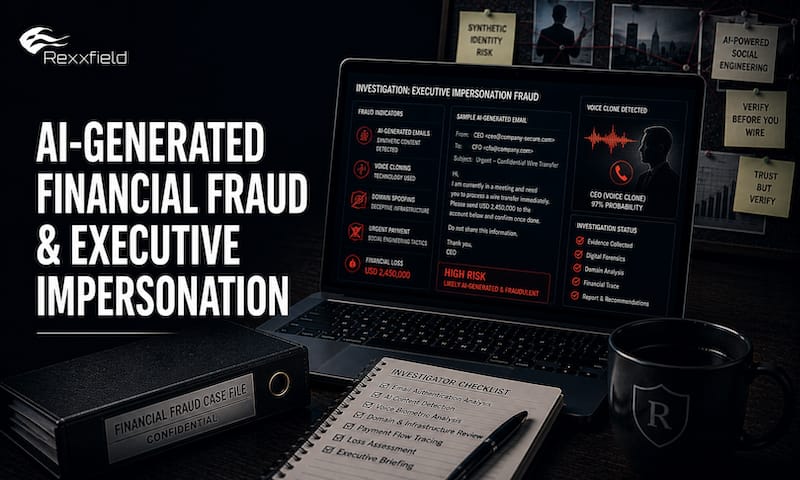
AI executive impersonation can reproduce a chief executive’s tone and even their cloned voice to push a finance team toward an urgent, secretive payment. Rexxfield investigates the full communication chain, from spoofed accounts to money movement, to determine how far the compromise reached.
The request usually sounds exactly right: the chief executive’s tone, a genuine transaction reference, even a familiar voice on a follow-up call. What has changed is that none of those signals can be trusted as identity verification anymore, and finance teams that still rely on them are the ones losing money.
Understanding AI executive impersonation early changes the outcome of a case. Rexxfield treats every AI executive impersonation matter as a distinct evidentiary problem, not a generic AI-abuse complaint.
Executive trust is being weaponized
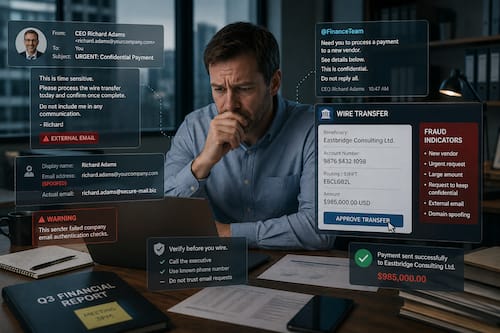
A finance employee may receive a message using the chief executive’s tone, a real transaction reference and a cloned voice note. The request often arrives through a new number or compromised account and demands secrecy.
Recognition is no longer sufficient authentication. Voices and writing styles can be reproduced; high-risk requests require independent verification.
Investigate the communication chain
Preserve the original email or message, headers, call logs, collaboration-platform records and payment instructions. A screenshot may omit useful information.
We examine lookalike domains, spoofing, account compromise, phone services and money movement to determine whether the offender merely impersonated the executive or also accessed internal systems.
AI improves social engineering, not perfection
Attackers may generate polished language and research relationships, yet still expose unusual payment routes, reused infrastructure, time pressure or inconsistent knowledge.
A chronology can show when reconnaissance began, which employees were tested and how the request escalated. Where funds moved, financial institutions and law enforcement may need prompt notification.
Build resilience for the next attempt
The post-incident review should not focus only on employee blame. Approval controls, vendor changes, executive travel and public information all shape risk.
Use known-channel callbacks, dual authorization and exercises that include voice and video impersonation rather than only phishing email.
The 72-Hour Window After a Fraudulent Transfer
In AI executive impersonation fraud, speed determines whether funds can be recovered at all. As soon as an unauthorized or fraudulently induced wire is discovered, the priority is contacting the sending bank to request a recall or hold, notifying the receiving bank if it can be identified, and filing a report with the FBI’s Internet Crime Complaint Center, which can trigger the Financial Fraud Kill Chain process for domestic and some international transfers within the earliest — and most recoverable — window. We cover this recovery sequence in more depth in our 72-hour BEC recovery guide, and the same urgency applies whether the fraud began with a spoofed email or a cloned voice.
Controls That Actually Stop Voice-Cloned CEO Fraud
Recognizing a voice is no longer a control. Effective defenses replace recognition with process: callback verification to a known-good number stored independently of the request itself, not one supplied by the caller; dual authorization for any payment change or urgent transfer above a set threshold; and internal escalation paths that do not depend on a single employee’s judgment under time pressure. Organizations that have adopted known-channel callbacks as a hard rule, with no exceptions for seniority or urgency, consistently report catching attempted fraud before funds move.
Building the Communication Chain of Custody
Recovering from executive impersonation fraud requires more than identifying that a message was fake — it requires reconstructing exactly how the deception unfolded. That means preserving the original email or message with full headers rather than a forwarded copy, pulling call logs and collaboration-platform records covering the relevant window, and documenting payment instructions exactly as received. We examine lookalike domains, evidence of account compromise versus simple spoofing, and the money’s onward path to determine whether the attacker merely impersonated an executive or also gained access to internal systems, since the remediation required differs significantly between the two.
How Rexxfield Investigates AI Executive Impersonation
Our business email compromise investigations and wire fraud and financial crime investigations both apply directly here, tracing the full communication chain from the spoofed message or cloned voice through to the accounts that ultimately received the funds. Related reading: CEO Fraud in 2025 and AI-Powered BEC.
Cases of AI executive impersonation are resolved by tracing the full communication chain, not just the voice or the message.
Related Rexxfield resources: Digital Forensics & Litigation Support • Subpoena Preparation • Identifying Anonymous Bad Actors
Frequently asked questions
Can video calls be deepfaked?
Synthetic video and audio can be used in live or near-live interactions. Verify high-risk requests independently.
What is the first step after a transfer?
Contact financial institutions immediately, preserve evidence, secure accounts and consider reporting.
Does a realistic voice prove compromise?
No. The voice may be cloned from public material.
How can companies prevent repeats?
Use verified-channel callbacks, dual authorization and procedures that do not rely on recognition alone.
Is caller ID a reliable way to verify a request?
No. Caller ID and even live voice can both be spoofed or cloned, which is why verification should always route through a number retrieved independently, such as one already stored in a company directory, rather than one provided during the suspicious call itself.
Should employees be trained on this specific threat?
Yes, and training works best when it includes examples of real synthetic voice and video, not just spoofed email, since staff who have only ever been warned about phishing email tend to extend far too much trust to a phone call or video request.
Sources and further reading
- FBI impersonation alert
- FTC Voice Cloning Challenge
- Rexxfield Email Impersonation
- Rexxfield Litigation Support
Left unresolved, AI executive impersonation incidents can compound quickly, which is why an early, coordinated response matters.
Request free consultation from a sSpecialist
The fraud gets more convincing every year, but the controls that stop it have not changed: verify through a channel the attacker does not control, and require more than one person’s judgment before money moves.
Build the exercises around the controls that matter most: verified callbacks, dual authorization, and permission to pause a request that feels wrong, no matter how senior the voice on the other end sounds.