When private company documents show up in the wrong place, it hits hard. One leak can spread fast and far, especially if it lands in the inbox of a journalist, competitor, or angry client. You might be looking at reputational damage, broken trust with your team or partners, and even legal or regulatory trouble.
If it’s already happened, don’t panic. There are clear steps you can take to contain the damage and figure out exactly where the leak came from. This guide builds on what we covered in our blog about tracking down anonymous whistleblowers, and it’s written for organizations that need to respond quickly and smartly.
Step 1: Don’t Delete Anything, Save Everything
Your first instinct might be to get the content taken down or shut the leak down fast. But before you act, slow down and collect the evidence.
Take full-page screenshots with visible timestamps and URLs. Download copies of the documents and any posts or emails they were shared through. If the leak appeared on social media or forums, use tools like Archive.today or Hunchly to preserve a tamper-proof version. Once a post is deleted or edited, it gets much harder to prove what actually happened.
If anything was emailed to you, grab the full message headers too. They often contain valuable clues about the sender’s IP address and email provider, which can help in an investigation.
Step 2: Speak to Your Legal Team Before You Make a Move
Whether the leak was malicious or accidental, your legal team should be looped in right away. If the person responsible had signed a non-disclosure agreement or confidentiality clause, this may be grounds for a civil case. If sensitive data was shared, it might fall under privacy or data breach laws.
In the United States, you could be dealing with federal or state-level privacy rules. For example, California’s CCPA or Virginia’s VCDPA both have specific disclosure timelines. In Europe, GDPR may apply, especially if the documents include personal data or affect customer privacy. You’ll want a lawyer’s input to figure out whether the law sees this as a reportable breach, a contractual violation, or both.
Once that’s clear, your legal team can advise whether you’ll need a subpoena to gather more evidence, or if an internal investigation can get the answers you need.
Step 3: Investigate the Leak with Digital Forensics
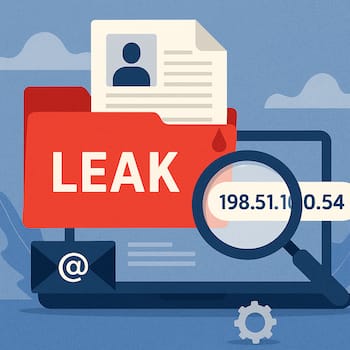 This is where companies usually hit a wall. The person responsible may have shared the files using a burner email, a VPN, or a fake social media account. They might have used Dropbox or Google Drive to pass around the link. On the surface, it looks like there’s no way to trace it back.
But with the right tools and techniques, there usually is.
At Rexxfield, we specialize in helping companies identify anonymous insiders and external actors behind leaks. We do this through a combination of digital forensics, metadata analysis, and behavioral profiling. Our job is to connect the dots in a way that stands up in court.
How We Trace a Leak
We start by looking at document access logs. Who had the document, when did they access it, and where from? Then we look at file metadata. Even if a document was renamed or copied, it can still carry traces of the original user, device, or creation time.
If the leak was shared online or via email, we collect information from the post or message. That includes IP addresses, time of activity, device type, operating system, and even browser language. Each of these data points can help narrow things down.
Even if a VPN was used, we’ve repeatedly been able to identify the source. People often make simple mistakes that break their anonymity. They might connect before the VPN fully loads, or use a browser fingerprint that matches other sessions. In some cases, we’ve even traced VPN use back to a specific provider or network.
We go beyond technical details too. Once we narrow the list of potential suspects, we look at behavior. For example, if the leak happened during a specific timezone’s work hours or includes information only a few people had, that helps confirm or rule out individuals.
Why Work With Rexxfield?
We’re not just tech investigators. We work hand-in-hand with legal teams to build evidence that holds up in court. Every report we deliver is designed to be usable in a courtroom, an HR hearing, or a regulatory complaint. We have testified in legal cases around the world, and our evidence has stood up to scrutiny every time.
Our goal is not just to find who did it, but to help your organization take the next step with confidence. Whether that means legal action or internal discipline, you’ll have facts you can rely on. We’ll take out the guesswork.
If your organization is dealing with a leak and needs help figuring out where it came from, we’re here to support that process with clarity and precision. Our job is to help you uncover the truth and protect what matters most.