Why Early Visibility Changes the Outcome
One of the biggest misconceptions we see is that smear campaigns start when they become visible. They don’t.
By the time something shows up in search results, gains traction, or turns into a broader reputation issue, it has already been developing in the background.
What we are seeing more and more is that these campaigns are structured. They are seeded, tested, and then amplified.
Monitoring & Protection Intelligence is the only reliable way to detect and stop these threats BEFORE they escalate.
It is far easier to prevent a smear campaign than to repair a damaged online reputation- Anna Hulst, Lead Investigator
What Is Monitoring & Protection Intelligence?
Monitoring & Protection Intelligence is a specialised approach to identifying, analysing, and stopping digital threats targeting high-profile individuals.
Unlike traditional monitoring, it is intelligence-led.
It focuses on:
- patterns, not just mentions
- intent, not just activity
- escalation risk, not just visibility
This becomes critical in cases involving:
- smear campaigns
- executive impersonation
- online defamation
- blackmail and coercion
For high-profile individuals, Monitoring & Protection Intelligence provides early visibility into risks that would otherwise go unnoticed.
Case Study: How We Identified and Stopped Escalating Threats Against a Public Figure
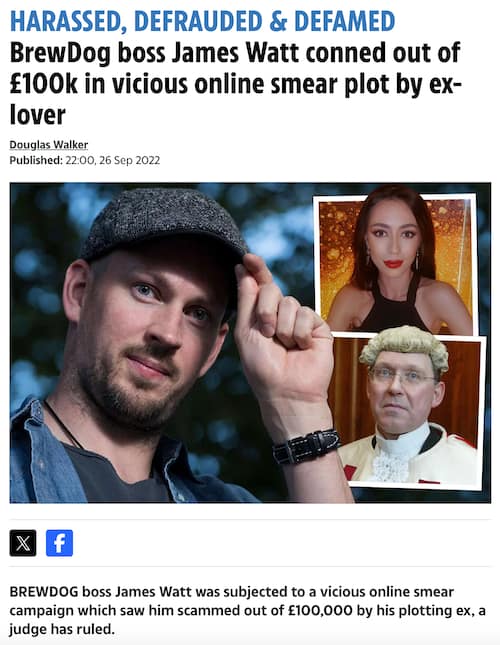 In a recent case involving a high-profile CEO, what initially appeared to be isolated online behaviour quickly escalated into targeted cyberstalking.
The same individual began appearing across multiple platforms, increasing in frequency, focus, and intent. What started as online attention developed into behaviour that required immediate risk assessment.
Rexxfield was engaged to:
- identify the individual behind the activity
- assess intent and escalation risk
- determine whether the threat extended beyond digital
Through structured investigation and intelligence analysis, we were able to attribute the activity, understand the level of risk, and support appropriate protective measures.
The case was widely covered in the media. You can read the full story here: https://www.thetimes.com/uk/scotland/article/brewdog-boss-scammed-out-of-100-000-by-ex-girlfriend-in-smear-campaign-htk9rtwm2
Contact our investigators for free consultation
How Smear Campaigns Start (What We’re Seeing)
In most of the cases we deal with, the early signals of a smear campaign are easy to dismiss.
It often starts with:
- Newly created accounts referencing an executive
- Low-engagement posts introducing a narrative
- Small clusters of accounts repeating similar claims
- Old or misleading information resurfacing
Individually, these don’t look like a serious issue. But when you step back and analyse the behaviour, patterns emerge.
That is typically where we identify a coordinated reputational attack beginning to form.
More about how we help public figures.
The Real Problem: No Monitoring Until It’s Too Late
Most individuals only act once something becomes visible.
At that point:
- The narrative has already spread
- Content has been indexed
- Third parties may have amplified it
Now it becomes a containment issue, not a prevention issue.
And that is always more complex.
A well-documented example of a digital smear campaign can be seen in the case of Wayfair, where a baseless conspiracy theory spread rapidly online, falsely linking the company to child trafficking. What started as fringe posts quickly escalated across platforms like Reddit, Twitter, and YouTube, gaining millions of views and widespread attention.
Despite being completely unfounded, the narrative caused significant reputational damage, forced public responses, and demonstrated how quickly coordinated or viral misinformation can impact a company and its leadership.
This is exactly the pattern we see in many of the cases we handle. The issue doesn’t start when it becomes mainstream. It starts much earlier, when the signals are still easy to dismiss.
“By the time a client calls us about a smear campaign, it’s usually already been in motion for some time. The real opportunity is catching it when it still looks insignificant to everyone else.”
— Stephen Dougherty, CEO, Rexxfield
That gap is where most of the damage happens. Early signals rarely look urgent. But they are often the most important.
What Monitoring & Protection Intelligence Actually Delivers
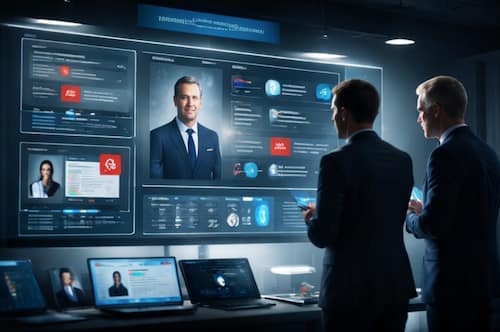 In practice, Monitoring & Protection Intelligence focuses on identifying:
- Early-stage narratives before they gain traction
- Executive impersonation at the point of creation
- Coordinated behaviour across platforms
- Signals linked to defamation, harassment, or blackmail
The key advantage is time. Time to understand what is happening. Time to assess whether it is credible, and time to act before escalation.
Without Monitoring & Protection Intelligence, these threats often go unnoticed until they are already public.
Monitoring Alone Is Not Enough
One of the biggest gaps we see is reliance on tools that generate alerts without context. A mention does not equal a threat. But a pattern of behaviour often does. Our role is to interpret what is actually happening:
- Is this coordinated or random?
- Is there intent behind the activity?
- Is this likely to escalate?
- Who is behind it?
“Most of what matters never shows up as a single alert. It’s the pattern behind the activity that tells you whether something is about to escalate.”
— Ronnie Tokazowski, CTO, Rexxfield
This is where Monitoring & Protection Intelligence becomes critical. It turns fragmented activity into a clear picture of risk.
Without Monitoring & Protection Intelligence, the pattern is predictable. The issue develops quietly. It gains traction, and it becomes public. At that point, containment becomes significantly more difficult. Even if resolved, the impact often remains, whether in search results, perception, or ongoing exposure.
When Should You Start Monitoring?
Ideally, before anything happens.
In reality, most clients engage when something feels off, when a fake or impersonation account appears, or when negative narratives start to form online.
But in our experience, these signals are rarely isolated. They are usually early indicators of something developing beneath the surface.
Contact our investigators for free consultation
From Monitoring to Investigation and Response
This is where Monitoring & Protection Intelligence becomes valuable.
Our reporting is designed to identify these early signals and turn them into a clear understanding of risk exposure. That includes:
- detecting emerging narratives before they gain traction
- identifying impersonation and fraudulent accounts at an early stage
- mapping patterns of behaviour that indicate coordination
- highlighting exposure risks across platforms, including indirect targeting
- assessing whether activity is likely to escalate
The focus is not just on what is visible, but on what is developing.
This allows for early intervention, when options are still available and before the situation becomes public.
In many cases, that early visibility is what prevents a reputational issue from becoming a full-scale smear campaign.
How Monitoring & Protection Intelligence connects to full investigations into smear campaigns, impersonation, and coordinated attacks.
 Why High-Profile Individuals Are Being Targeted More
We see a clear increase in targeted activity against:
- CEOs and senior executives
- Founders and public-facing leaders
- Family offices and principals
- High-net-worth individuals
The reason is straightforward. Visibility creates leverage.
High-profile individuals sit at the intersection of reputation, decision-making, and financial value. That makes them uniquely exposed. In practice, what we see is that targeting an individual is often more effective than targeting an organisation. It creates faster pressure, is more personal, and is harder to control once it becomes public. That is why these individuals are targeted for:
- reputational pressure during disputes or negotiations
- financial gain through fraud, impersonation, or extortion
- influence over business decisions or outcomes
- disruption, particularly in competitive or high-stakes environments