When someone from inside your company leaks confidential information, the fallout can be immediate and damaging. News spreads quickly. Trust from investors or partners starts to fade. Internally, people feel unsettled. Clients may walk away, especially if the claims, true or not, affect your reputation. The hardest part is that when the leak comes from internal anonymous whistleblowers, it feels more believable and harder to contain.
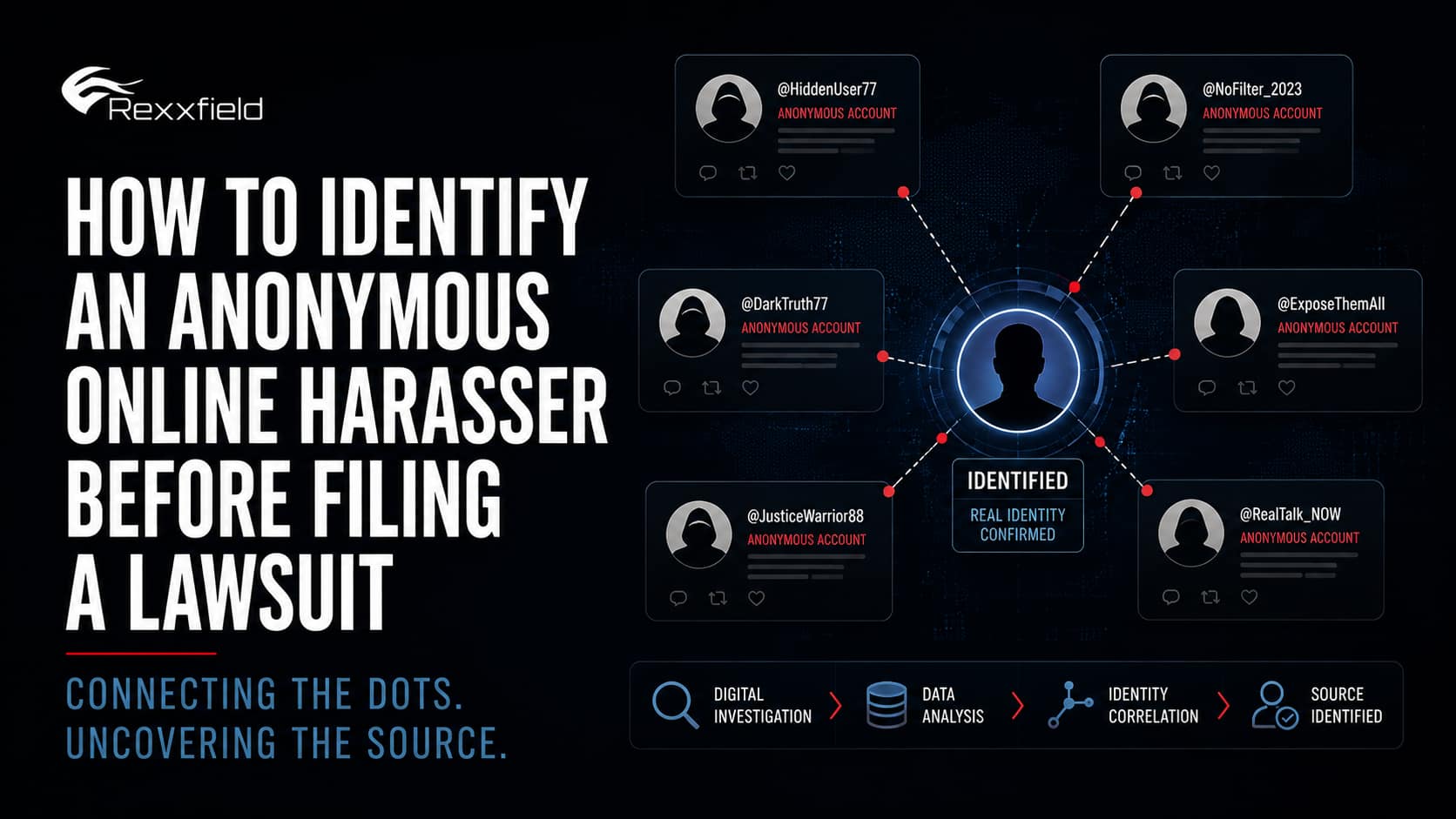
Most organizations feel stuck in situations like this. Anonymous whistleblowers often hide behind encrypted emails, burner social media accounts, or third-party reporting platforms. But anonymity is not bulletproof. With the right investigative tools and approach, it’s often possible to trace that person and understand exactly what happened.
At Rexxfield, we specialize in unmasking anonymous users. Our work has helped businesses, law firms, and high-profile individuals trace internal leaks to a single source and take swift legal action backed by solid evidence.
What are Anonymous Whistleblowers?
Anonymous whistleblowers are individuals who share confidential or damaging information about a company or organization without revealing their identity. They often leak information to clients, investors, the media, regulatory bodies, or activist groups. They may involve:
- Internal misconduct
- Security breaches
- Alleged fraud
- Policy violations
- Personal attacks on executives or staff
While whistleblowing can absolutely serve a public interest, not all reports are honest or accurate. When whistleblowers act maliciously or publish false information, businesses have a right to investigate and respond.
When Is It Legal to Investigate Anonymous Whistleblowers?
Whistleblower protections exist for good reason, but they are not always absolute. In many places, the law only shields employees if they follow the right reporting procedures and act in good faith. If someone shares false claims, leaks confidential information, or violates a nondisclosure agreement, the company may have every right to investigate who was behind it.
The rules differ depending on where you are:
- United States: The Whistleblower Protection Act mainly applies to federal employees or contractors, and only when they go through the proper legal reporting channels.
- United Kingdom: Under the Public Interest Disclosure Act (PIDA), protection is only granted when the disclosure is genuinely in the public interest.
- Australia: The Corporations Act offers whistleblower protections, but anonymous reports must be submitted to eligible recipients like legal advisors or regulators.
- European Union: The EU Whistleblower Directive lays out broad protection, but how it is interpreted and enforced varies between member states.
We always advise getting legal advice before starting an investigation. At Rexxfield, we work closely with legal teams to make sure every action taken is legitimate and defensible. Our role is to uncover facts while staying within legal boundaries.
How We Track Down Anonymous Whistleblowers
1. Behavioral and Linguistic Profiling
 We start by analyzing the whistleblower’s message. Language patterns, writing style, common phrases, spelling quirks, and formatting can often be linked to known employees. This method, often called linguistic fingerprinting, has helped us narrow down suspect lists in dozens of cases.
We also assess behavioral traits. The timing of messages, the kind of information shared, and how someone might have gained access to it often reveal more than they realize.
However, linguistic clues alone are never enough. They just help point us in the right direction, but we need suspects to rule in or rule out their involvement, based on hard digital evidence. And that is exactly what we specialize in: backing up pattern recognition with forensic-level metadata, device tracking, and activity logs. This way, our clients aren’t left with guesswork. We provide evidence that’s fully legal, admissible and very compelling in court.
2. Social Engineering and Metadata Collection
When someone sends an anonymous tip through email or a messaging app, they often give away more than they think. Behind the message, there can be revealing details about the sender’s device, location, or IP address. Our team uses ethical and lawful interaction methods to collect this kind of metadata, which can include:
- IP addresses
- Device type and operating system
- Browser and language settings
- Timestamps of activity
If we already have a few potential suspects, these digital traces can help confirm who was behind the message or rule others out entirely. And while VPNs and proxies might sound like a solid way to stay hidden, they are not foolproof.
We can bypass VPNs.
At Rexxfield, we have bypassed VPN protection many times. Anonymous whistleblowers assume they are fully shielded, but the reality is we have ways to bypass VPNs if suspects are involved.
Once we narrow it down to a couple of strong suspects, legal steps like subpoenas are not always necessary. But if one is needed, the technical evidence we gather helps ensure it is tightly focused, faster to process, and far more likely to succeed. This can mean less time spent, fewer legal hurdles, and a better outcome for your organization.
Our Evidence Is Court-Ready
At Rexxfield, we do not just find the data. We help you build a strong, usable case. Over the years, we have worked closely with lawyers and legal teams to support both civil and criminal proceedings. From day one, we structure our investigations with court in mind.
We understand how evidence needs to be collected, documented, and presented. Our reports are formatted for legal use and can be submitted in court, HR hearings, regulatory disputes, or mediation. Everything we produce is built to stand up under scrutiny.
Unlike many digital investigators, we do not stop at analysis. We have been called to testify in courtrooms around the world, and our evidence has held up again and again. When legal teams need clarity, we are there to walk them through the technical aspects and help explain exactly how the data links back to a suspect.
Our team has decades of experience helping clients move from suspicion to solid evidence. When you bring us on board, you are not just hiring a cyber investigator. You are adding someone to your team who knows how the legal system works and what it takes to succeed in court.
Contact Rexxfield for a free, confidential consultation
Case Study: How BrewDog CEO James Watt Tracked Down an Anonymous Smear Campaign
 When James Watt, the co-founder of BrewDog, started noticing a wave of damaging claims circulating online, he knew he could not ignore it. The posts were false, deeply personal, and clearly designed to hurt both his reputation and his company. They appeared on social media and in emails, and whoever was behind it seemed to be going to great lengths to stay anonymous.
It was not just a few offhand comments. The person responsible was running a full-scale campaign using fake accounts, burner email addresses, and VPNs to stay hidden. It looked like they had covered their tracks completely. But James wanted answers, and he wanted the attacks to stop.
Identifying the Person Behind the Screen
The investigation eventually led to the identification of the person behind the smear campaign: James’s former partner, Emili Ziem. She had set up a coordinated effort to spread false stories using multiple anonymous online identities. Each detail had been carefully planned to make it seem like she could not be traced.
She relied on VPNs to hide her location and make it appear as though the messages were coming from different places. On the surface, the digital trail looked clean. But it wasn’t.
At Rexxfield, we used our digital forensics tools and methods to break through the layers of obfuscation. Despite the VPNs and fake accounts, we were able to find and trace back key metadata that pointed directly to Ziem.
This evidence proved critical. The case led to her criminal conviction, and she was ordered to pay £600,000 in damages. Not only did this restore James’s reputation, but it also sent a strong message to anyone who thinks anonymity online is untouchable.
How Rexxfield Helped Uncover the Truth
James Watt brought in Rexxfield to find out who was behind the attacks. Our investigators began by looking at the digital trail. Even when someone uses VPNs or fake accounts, there are often small mistakes that can expose them. In this case, we focused on device fingerprints, session metadata, account behavior, and other digital clues that most people do not realize they are leaving behind.
We discovered consistent patterns across multiple anonymous accounts. These patterns matched behaviors we later tied back to Emili. Although VPNs had been used, we found ways to work around them. By identifying metadata that was missed during setup and comparing digital habits, we were able to build a full picture of who was behind the attacks.
The evidence we collected was strong enough to take to court. It clearly linked the activity back to one individual, despite the efforts to stay anonymous.
The Result: Conviction and Restitution
James Watt took legal action. With our support, the case was built on solid investigative evidence that showed exactly what had happened and who was responsible.
- Emili Ziem was convicted in court.
- She was ordered to pay restitution of more than £600,000 (approximately $675,000 USD).
Watt later decided to speak publicly about the case to help others understand that online defamation can be investigated successfully, even when someone is using anonymity as a shield.
Media coverage included:
Why This Case Matters
This case proves that anonymity online is not bulletproof. Even the most carefully planned digital cover-ups can fall apart when the right investigative methods are used. VPNs, burner accounts, and fake names are not enough to guarantee anonymous whistleblowers can get away with online harassment or defamation.
At Rexxfield, we specialize in tracing anonymous activity back to real people. Our work stands up in court and has helped clients in high-stakes cases around the world.
Need Help Tracking Down Anonymous Whistleblowers?
If your organization is facing leaks, anonymous threats, or damaging disclosures, you don’t need to feel powerless. Rexxfield can help identify the source and give you the evidence you need to take action.
Contact Rexxfield for a free, confidential consultation
For more background on our methods and legal options for anonymous user tracing, see: