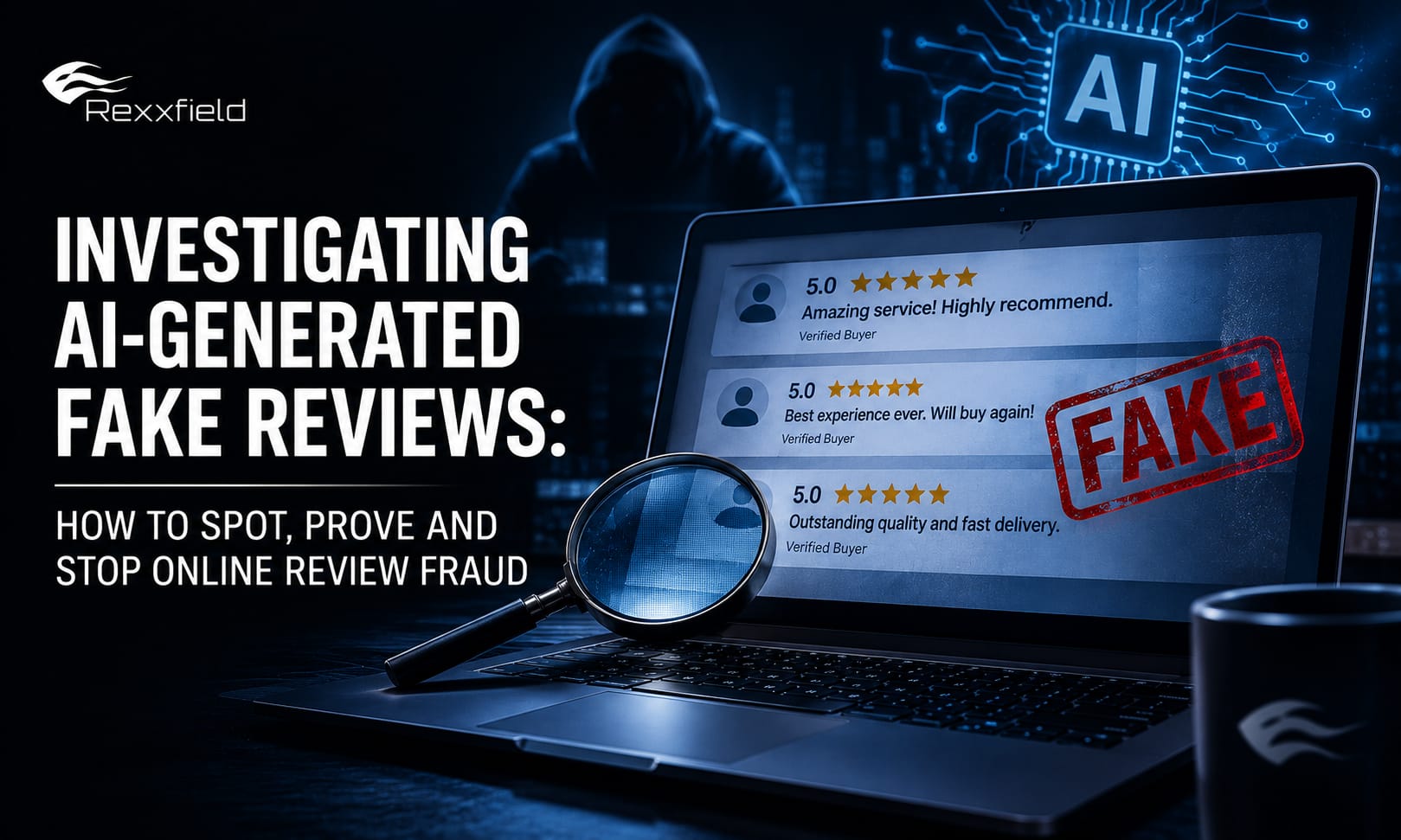
AI fake reviews can flood a business with varied, convincing complaints that create a false appearance of widespread dissatisfaction. Rexxfield examines account history, timing and cross-platform patterns to build a factual record that supports platform escalation and legal action.
A cluster of near-identical one-star reviews rarely comes from a genuine wave of angry customers. More often it traces back to a single operator using generative tools to vary tone, add plausible detail and space out posting times so the pattern looks organic — and the business paying the reputational cost has no easy way to tell the difference on its own.
Understanding AI fake reviews early changes the outcome of a case. Rexxfield treats every AI fake reviews matter as a distinct evidentiary problem, not a generic AI-abuse complaint.
False consensus at scale
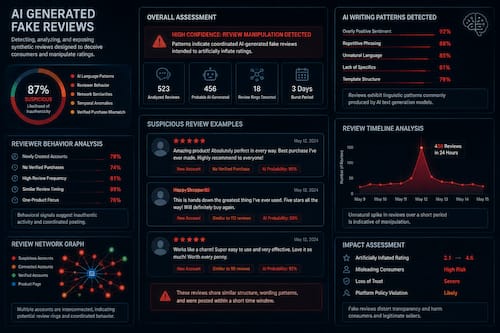
Generative AI can produce varied stories, change tone and include plausible industry detail. One operator can distribute reviews across search platforms, social networks and complaint sites.
The harm comes from apparent consensus. A cluster of seemingly independent complaints can affect sales, recruitment and professional standing, then be cited in later articles or sent directly to customers.
Patterns matter more than prose
AI text detectors are not a dependable way to prove a review is false. A genuine customer may use AI to improve grammar, while an offender may heavily edit generated text.
We examine account history, timing, claimed location, factual knowledge, repeated errors and links with other campaign assets. The aim is a factual record that can support platform escalation and legal advice.
Preserve before reporting
Capture the full URL, profile details, date, rating, visible history and surrounding context before seeking removal. Internal customer, appointment and refund records may help test allegations.
Counsel should control outreach to suspected reviewers so the company does not create retaliation or spoliation problems.
From abuse report to attribution
A review campaign may connect to fake social accounts, anonymous email, a competitor dispute or a former employee. We map those relationships before deciding which records are most valuable.
Where legal process is needed, focused technical requests are generally more useful than broad demands. Rexxfield assists counsel with subpoena wording and analysis of provider returns.
How Platforms Handle AI-Generated Review Complaints
When it comes to AI fake reviews, most major review platforms will not remove a review simply because it “reads like AI,” and reporting it on that basis alone is usually rejected. What tends to work is evidence tied to the platform’s own policies: proof the reviewer never transacted with the business, multiple accounts sharing registration details or device fingerprints, or a documented pattern of coordinated posting across several listings. Google, Amazon, Yelp and the Better Business Bureau each have different evidentiary thresholds and different escalation paths, so a report built for one rarely transfers cleanly to another.
Legal Options Beyond Platform Removal
When a review campaign contains false statements of fact rather than opinion, a defamation claim may be available once the author can be identified. Where a competitor is suspected of driving the campaign, false advertising or unfair competition claims can sometimes apply alongside defamation. In either case, a John Doe lawsuit paired with subpoenas to the platform, hosting provider or payment processor is often the mechanism that turns an anonymous username into a named, accountable party.
Building the Internal Record Before You Escalate
Before filing any platform report, capture the full review text, the reviewer’s profile history, the exact URL and timestamp, and the star-rating trend for the surrounding period, since platforms frequently edit or remove content once a dispute is flagged. Cross-reference each suspect review against internal records: customer databases, appointment logs, refund history and support tickets. If no matching transaction exists, that absence becomes part of the evidentiary record. We also compare language patterns, complaint specifics and posting cadence across the suspect reviews themselves, since a genuine wave of independent complaints tends to vary far more in structure and detail than a generated one.
When a Former Employee or Competitor Is Behind It
A disproportionate share of coordinated review campaigns trace back to someone with insider knowledge — a former employee, a disgruntled contractor, or a direct competitor rather than a stranger. These campaigns often reference internal details a random reviewer would not know, which is itself a useful investigative lead. We look at timing relative to terminations, disputes or competitive events, since a cluster of hostile reviews appearing within days of a departure or a lost contract is rarely a coincidence.
How Rexxfield Investigates AI Fake Reviews
Our online defamation investigation work and our approach to helping clients identify anonymous antagonists both apply directly to fake review campaigns, since the same account-pattern analysis that unmasks an anonymous harasser also links supposedly independent reviewers back to one operator.
Our work investigating AI fake reviews focuses on account patterns and cross-platform links rather than writing style alone.
Related Rexxfield resources: Digital Forensics & Litigation Support • Subpoena Preparation • Identifying Anonymous Bad Actors
Frequently asked questions
Can AI-written reviews be detected reliably?
Not from wording alone. Account behavior, timing, business records and campaign connections matter more.
Should a company respond publicly?
A neutral response may be appropriate, but avoid accusing a suspected reviewer without evidence.
Can platforms disclose identities?
Potentially through valid legal process, subject to jurisdiction and available records.
What should be preserved?
The review, URL, profile, date, account history, related messages and relevant internal records.
Should a business respond publicly to a suspected fake review?
A brief, neutral public response is usually appropriate, but naming or accusing a specific reviewer without confirmed evidence can create new legal exposure for the business, so we recommend holding direct accusations until an investigation supports them.
Sources and further reading
- Rexxfield Fake Review Investigation
- Rexxfield John Doe Guide
- Rexxfield Subpoena Preparation
- NIST Generative AI Profile
Left unaddressed, AI fake reviews can compound quickly across platforms, which is why early evidence capture matters.
Talk to an AI sSpecialist
AI fake review campaigns will keep getting more linguistically varied, but the underlying tell remains structural rather than stylistic: accounts, timing and transaction history that do not add up to genuine, independent customers.